Thesis: US Military presence in Afghanistan continues primarily for economic benefit, and not anti-terrorism.
Timeline
1965 - People's Democratic Party of Afghanistan founded (Communist).1973 - Mohammad Sardar Daoud Khan seizes power in a coup after economic hardship from a corrupt royal family.
1978 - PDPA seizes power in a military coup, killing Khan and his family. Nur Mohammad Turaki names himself President and begins replacing religious law with Marxist-Leninist law. Women were given the right to vote, forced marriage was outlawed and economic assistance from the Soviet Union began pouring in to build infrastructure.
1978 - PDPA secures billions in promised assistance from the USSR, and tortures/murders 100,000 religious and academic leaders.
1979 - Religious leaders begin insurrection against the secular government, reaching 24 of 28 provinces. Half of the Afghan army defects or joins the insurrection due to the government suppression of Islam.
1979 - Due to the Iranian Revolution the US tries to get involved in Afghanistan, tries to dissuade the USSR from invasion. The US Ambassador to Afghanistan is kidnapped and murdered. US pulls aid to Afghanistan and increases aid to Afghan refugees in Pakistan.
1979 - 1989: Soviets invade and occupy Afghanistan for ten years. The CIA sends aid to the Mujahedin (Islam) to fight the soviets due to concerns over Soviet control of Afghan oil.
1992 - Islamic State of Afghanistan founded. Islamic militias begin fighting each other with support from Iran, Pakistan and Saudi Arabia.
1996 - Afghanistan descends into chaos.
1996 - 2001: The Taliban begin attacking and controlling provinces. The Taliban, bin Laden's 055 begin massacring hundreds of thousands of civilians. Pervez Musharraf (then chief of Army) sent Pakistani soldiers to help.
1998 - Taliban blocks Bill Clinton's new oil pipeline through Afghanistan.
2000 - First Predator flight over Afghanistan films bin Laden and his crew walking down the street.
2001 - First armed Predator blows up a copy of bin Laden's house in Nevada. In June.
2001 - September 4 Condi Rice and security leaders stop armed Predator strike plans.
2001 - Ahmad Massoud is the only remaining leader of non-Taliban provinces. He travels to Europe to beg for humanitarian aid and denounces the Taliban and Al Qaeda as poor examples of Islam. Massoud warns US officials of imminent Al Qaeda attack on the US. He is assassinated on September 9.
9/11 - US immediately blames bin Laden for attacks.
stuff... stuff... stuff...
2003 - US demands Taliban to turn over bin Laden. They refuse. We invade.
2011 - Bin Laden killed
2011 - Obama commits US military presence in Afghanistan through 2024.
Present: Northern Distribution Network is built and protected by the US Army, ostensibly to provide non-lethal supplies for Army operations. At the same time friendly governments in the -stans increase oil production in the Central Asia/Caspian region.

Coincidentally the Northern Distribution Network provides a fast-track to the Persian Gulf for oil, without the inconvenience of having to go through Iran or Iraq:
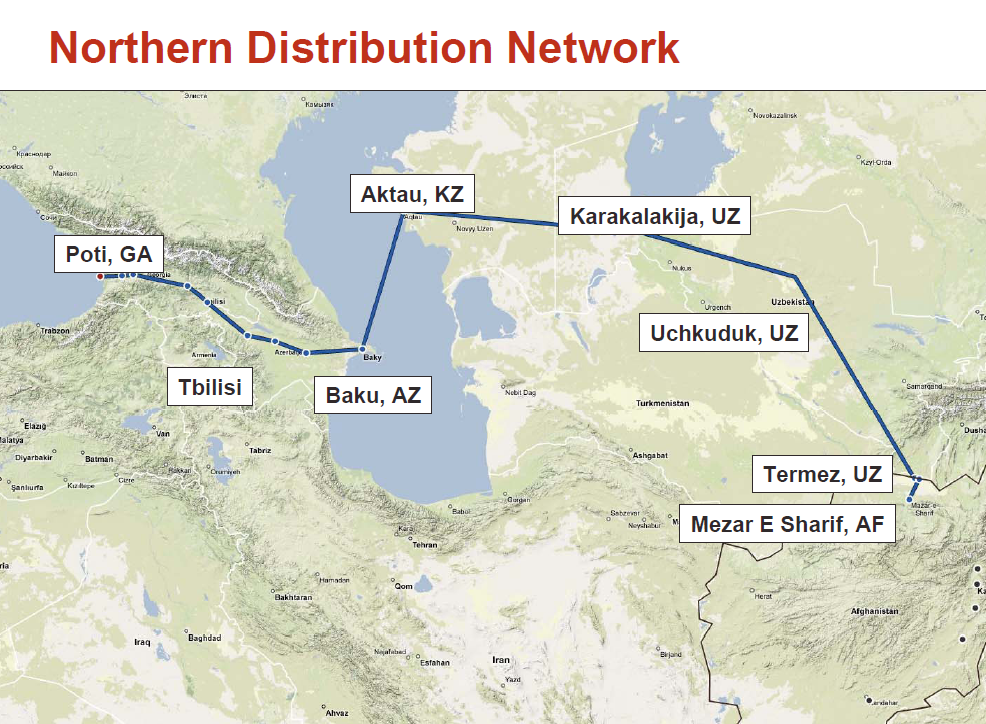

The US currently pays $500 million per year to nations in the NDN infrastructure:
http://www.eurasianet.org/node/64969
The final leg of the NDN travels through Pakistan, and would require Pakistan's support. Continuing support would be damaged by US accusations of Pakistan being an accomplice to bin Laden.
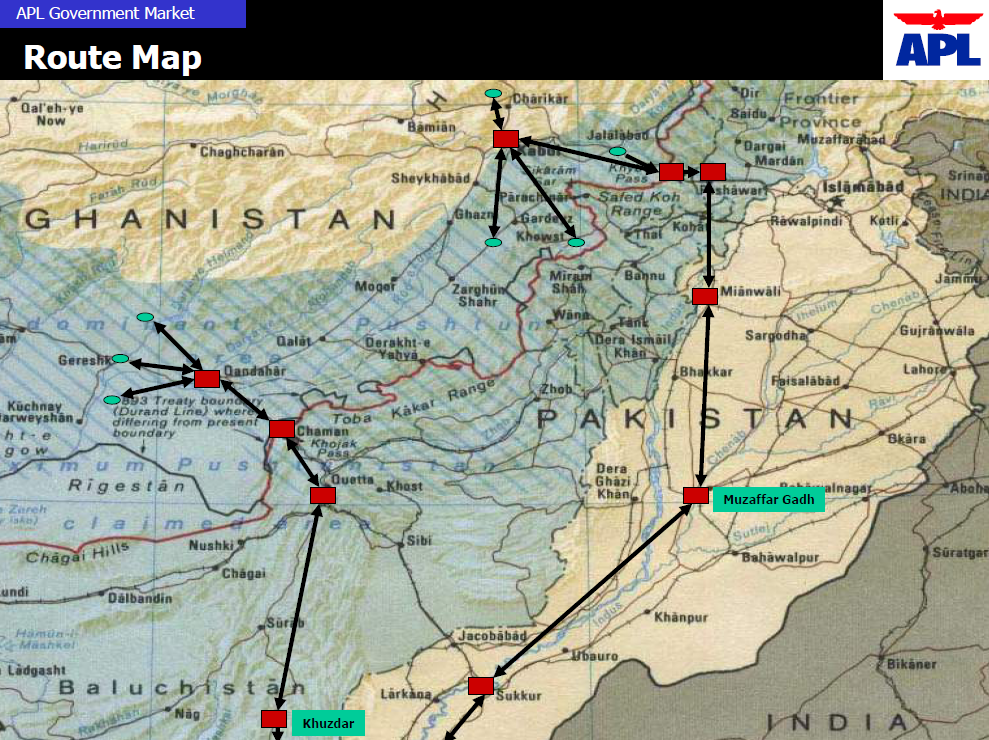
Afghanistan currently has very little hydrocarbon production, but modest oilfields have been discovered near Angot, in Northern Afghanistan.
Transportation infrastructure and security are critical for oil and gas development. Along with the massive petroleum reserves in Central Asia and the Caspian Sea, new oilfields have been discovered and energy companies are noticing.
A tender will be offered later in 2012 to develop a larger oil field in Balkh Province (Kasha Kari bloc), estimated to hold 1.8 billion barrels of oil. Exxon-Mobil is reportedly weighting a bid on the project—an action that Afghan officials say would instill substantial confidence in the investment climate in Afghanistan. (Congressional Research Service)The endgame, in my opinion is now apparent:
"USAID has funded test projects to develop gas resources in northern Afghanistan. Building on
that aid, there is increasing optimism that private investors will fund at least 25% of a $300
million needed investment for a 200 megawatt gas-fired thermal plant in northern Afghanistan.
The plant would be part of a plan to link Afghanistan’s natural gas field in Shehbergan to the
population center in Mazar-e-Sharif.
TAPI (Turkmenistan-Afghanistan-Pakistan-India) Gas Pipeline Project. Another long-stalled
major energy project appears to be gaining momentum. During 1996-1998, the Clinton
Administration supported proposed natural gas and oil pipelines through western Afghanistan as
an incentive for the warring factions to cooperate. A consortium led by Los Angeles-based Unocal
Corporation proposed a $7.5 billion Central Asia Gas Pipeline that would originate in southern
Turkmenistan and pass through Afghanistan to Pakistan, with possible extensions into India.70
The deterioration in U.S.-Taliban relations after 1998 suspended hopes for the pipeline projects.
At a summit meeting in late May 2002, the leaders of Turkmenistan, Afghanistan, and Pakistan
agreed to revive the project. Sponsors held an inaugural meeting on July 9, 2002, in
Turkmenistan, signing a series of preliminary agreements. On December 12, 2010, in the
Turkmenistan capital Ashkabad, the relevant leaders reaffirmed their intent to complete the
project. In late 2011, the Asian Development Bank has agreed to finance the project, removing
what had been a major hurdle. U.S. officials view this project as a superior alternative to a
proposed gas pipeline from Iran to India, transiting Pakistan. "
Afghanistan: Post-Taliban Governance,
Security, and U.S. Policy
Kenneth Katzman
Specialist in Middle Eastern Affairs
August 17, 2012 - Congressional Research Service
So, if there are any local economic benefits created by a US military presence, it must be a conspiracy to create those benefits via the military. The causation could not possibly be the other way. Maybe you could do an expose on the Marshal Plan. Or the airline conspiracy that brought us the Berlin Airlift.
ReplyDeleteClearly, in the future, we must make sure that our military presence leads to absolutely no economic benefits for that region, just to avoid this kind of suspicion. We certainly wouldn't want the locals to think they might up better off!
I don't think they will be better off. We provided jobs constructing the roads and moving the supplies. Right now I believe we are just hanging around providing security.
DeleteWhen we leave the warlords will have the only good road crossing the country separated into sections of extortion that pass through their respective provinces.
But the question remains. Why commit thousands of military personnel to a place that hates us until 2024?
Another question: When the majority of troops leave in 2014, the massive supply route will no longer be needed. All the jobs and prosperity we provided go away because "military supplies" aren't flowing. Why build a giant transportation corridor from Europe, through Central Asia and then down through Afghanistan to the Pakistan shore? For military supplies?
Afghanistan has modest oil and gas deposits, perhaps enough to meet their needs and possibly sell a little. They don't need a pipeline.
Afghanistan has some decent mineral resources, namely Lithium, which is in exponential demand for batteries in hybrid cars. "Afghanistan" won't see any of that money, though. The investment will be by Chinese and global corporations, and so will the profit.
Bottom line... What gives? OBL is dead. We are told the war is over. One soldier per day, on average, has died this year.
I don't believe the 'military' is doing this. The military follows civilian mandates.
It makes no sense.
Also, if you will allow me... We didn't invade Afghanistan in 2003 as part of the "Global War on Unemployment of Indigenous Peoples of Afghanistan" or "Operation Economic Freedom".
DeleteWhy remain?
Mike, I think on substance, you have sketched the basic outline of the history of events. I cannot speak for Mr. Clinton, but I suspect that he saw an opportunity to (1) generate some economic activity in a region that desperately needed it in an attempt (perhaps vain) to create some social stability...provide "the street" with something to grab a hold of and make their own, and (2) provide a stable climate for U.S. foreign direct investment.
ReplyDeleteFast forward to 9/11. The U.S. response was a "alright, dammit, I've had enough" response the Taliban and their harboring and training of terrorists. I have no doubt that Mr. Bush's invasion of Afghanistan had nothing to do with oil pipelines. You have previously called it vengeance. It cannot be vengeance (an act of passion) and conspiracy (the product of cold calculation) at the same time. Now, perhaps some saw this as an opportunity to kill two birds with one stone (figuratively and literally, which Joe Biden does not know the difference). I cannot say because I cannot peer into their hearts.
But here are the cultural facts. First, the 'stans, and in fact the whole Persian, Central Asian, Arab region, is tribal. They have been at constant war with one another for thousands of years. As such, they only understand power. Pure, unadulterated, raw, power. They do not respond to diplomacy in the Western sense. Only who has the upper hand in terms of power. Second, they are EXTREMELY patient. They can tolerate oppression for generations and still strike like a snake at the moment weakness presents itself. For God's sake they still speak of the Crusades in the present tense. They lived under the yoke of the Russians for 10 years. Third, religion is only nominally involved. Religion is the means of controlling the population. Nobody from Saudi princes to OBL in the upper reaches of power gives a damn about religion. That is a tool to manipulate the pawns on the chess board.
So, we mistake our own abilities to have any influence over their culture. It was there before us and will be there long after we are gone. But, "bringing the rain" militarily and Obama's apparent willingness to commit troops for another 12 years says to the Taliban (and the locals inclined to support us), we are here to stay...get over it. That action, while seemingly terrible for our troops and families, has a significant effect on the morale of those that would wish to fight us. Will it work...who knows?
But, like the previous commenter, I think to look for a correlation between economic benefits and military presence is not the same as causation. In fact, may times our companies get the shaft as our Government bends over backwards to try to appear like "liberators, not occupiers."
Could the economic/financial potential benefits be overriding the better judgement of what is best for our troops and/or long-term stability in the region. Certainly. It would not be the first time we've screwed the pooch on something. But, all of the troops I speak to returning from Afghanistan are all engaged in counter-insurgency operations which say that, at least for now, the focus is on degrading and destroying terrorist targets. But, I cannot say for sure what the master plan is...
Great comments.
ReplyDeleteI think the "jobs for locals" idea has failed in the past, especially when the jobs cross tribal boundaries.
The Northern Distribution Network gained support from the locals because they could sign up and get paid to build roads.
I'm sure the original impetus was a military supply line, and I'm sure it was intended to be left in place after we leave.
I think, though, that no matter how long we stay things will go to hell the second the last boots step off Afghan soil.
I don't think (opinion, not experience) that we are on some kind of humanitarian mission now. Much of the population hates us because of exaggerated portrayals of American imperialists blowing up children with robot planes.
There may be fragments of Al Qaeda remaining in Afghanistan but I think the players have all moved away to Yemen, Saudi Arabia, Somalia, etc.
I do have an honest question though. I really don't understand this one. Why are we not in Sudan?
Good question. I suspect, more than anything, we continue to be in Afghanistan to keep Iran on notice. Obama promised an exit from Iraq, which he did. But, he (or is NSA) is not so dumb as to believe that Iran is just going away. IMO, I would have drawn down and out of Afghanistan and built up in Iraq...don't think today would have happened if the 4th ID were parked across the border from Damascus. Besides, as you say, Al Qaeda has moved on to Yemen and Somalia, so permanent bases in Iraq would have made more sense. We still could have struck at Afghanistan if needed quite easily and can hit Somalia and Yemen quite easily... but, what the hell do I know... I did see Lawrence of Arabia and I have stayed at a Holiday Inn Express...all the qualifications I need to be NSA I think.
DeleteAnd as for Sudan...I think we just have not decided which of the sides is the lesser of the evils yet. Sad...
DeleteYes, and unfortunately that's true for most of the world. It's all just shades of gray.
ReplyDelete